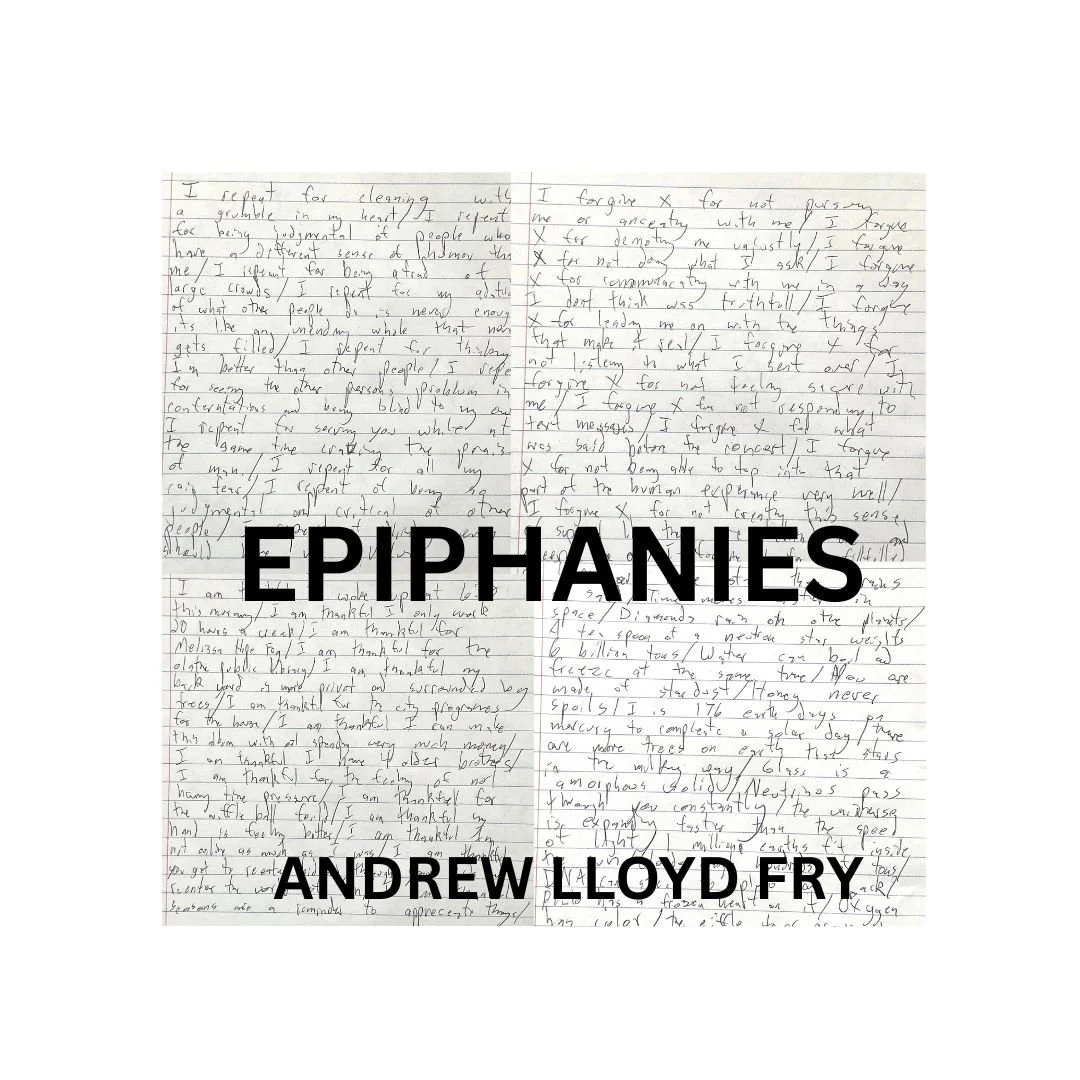
AN INTRODUCTION TO EPIPHANIES
Music For Repentance
The Idea: I have been thinking a lot about this topic over the last couple of years. I’ve reframed repentance from a point in time when you repented, into a habitual life style of repentance. I think if we take a step back, we realize how hard it is to own up to our mistakes, and often our default mode is to blame others.
The Music: This piece draws heavily from classical minimalism (specifically Philip Glass and Max Richter). A lot of the work is a repeated 5 chord cycle, and the melodic material is often pulled straight out of the harmony (i.e. chord tone heavy). The middle section is an example of what I am calling an “open score”. More and more I am moving into a hybrid of notation/improvisation. This section develops by the chord voicing becoming more active every cycle. Instead of this increase in activity being notated, there is simply a note in the score to increase intensity using this set chord voicing. This is both, more fun to perform and creates a more dynamic piece that can have variety from performance to performance. The work ends with a gentle melody, which is my favorite part of the work.
Music For Forgiveness
The Idea: Similar to my thoughts on repentance, I am now seeing forgiveness as a daily necessity. We often talk about forgiveness with the big stuff, like an abusive parent or something. But I am more thinking about this in terms of the daily small stuff (micro-forgiveness). Things like someone not responding to a text, or a tone of voice from a family member which felt slightly sharp. These types of events come up daily and often. I feel challenged to use forgiveness as a continual relational refresher. It’s like cleaning the window again and again.
The Music: This piece opens with some more “open score” material. The left hand is notated but the right hand is improvised. Once this introduction section ends, the rest of the piece is fully notated. The theme of this work is a slow and gentle melodic statement. As I reflect on it, it reminds me of Miles Davis ballad playing. Often he would play slow and gentle, but pick notes that are rubbing up against the harmony, creating a really effective emotional contrast. The work continually oscillates between this slow theme and big active sections. I really enjoy the shift of emotional tone at the end of this one when the piano moves into the staccato section. It almost sounds playful after being sober and heavy. It’s like experiencing a weight being lifted
Music For Thankfulness
The Idea: The reason we need thankfulness so bad is that we have a tendency (and it’s been scientifically proven) to double the weight of the bad things in our life. For example if we lost 50 dollars one week, and two weeks later was given 50 dollars unexpectedly, our emotional wight of these two events would still come out in the negative. Another way of saying this is losing 50 dollars is more negative emotional points, than being given 50 dollars is positive emotional points. To combat this weird human tendency we need thankfulness. It’s the path to a truer reality.
The Music: Music for thankfulness opens up with these rich and bright rolling chords. This opening reminds me of Debussy (who for me is my favorite composer of piano music). The music shifts in the second section where the texture is much more sparse and open. The end of the piece utilizes one simple melody over and over but continually recast with a new frame. When this piece is performed live this melody is also to be sung by the audience. To hear an example of this piece with the audience choir click here.
Music For Awe
The Idea: We live in a totally crazy universe and to not respond with awe and wonder is total blindness.
The Music: This piece is completely improvised other than the tiny 5 note melodic fragment stated at the beginning of the piece. I was surprised, when I came to the relazation I could get exactly what I wanted when I just jumped in and started improvising. More and more I’m trying to utilize the strength of notation, but drop it the moment it gets in the way of my compositional goals. This is also a super fun piece to play, and for me creates a sense of drama and excitement not fully knowing what’s going to happen next.